Three Steps to Funding Success

Preparation is everything when trying to raise money for a new venture. Entrepreneurs need to be thorough and anticipate the questions and requests that will be thrown at them – if they even get as far as a meeting with an investor.

The first step is to submit an Executive Summary that is no more than two pages long. The purpose of this document is to gain a meeting with an investor. Because of the brevity of this document, every element and every word counts. It must convince the investor that spending 30 minutes is worth his/her time. Miss this one, and the game is over!

The second step is to present a Pitch Presentation in PowerPoint for use in front of the investor. The entrepreneur must be sensitive to the time element and respect the amount of time the investor is willing to give. It can range from 10 minutes to one hour. This will determine the number of slides to pick, while making every one of them count. The order in which the slides/topics are presented is extremely important so as to not lose the investor’s attention. This presentation must hypnotize!

The third step is to present a Business Plan. If the Pitch Presentation was successful, the investor will ask for it. This document has many elements, and it is important that it considers the investor’s priorities. For example, most entrepreneurs are fixated on their product, while Investors are more interested to know whether there is a market that has a dire need and is ready to buy.

Final point: all three documents must be complete before approaching investors, and they are usually developed in reverse order. If the Executive Summary sizzles, the entrepreneur must be prepared to follow through immediately. It does happen!

Is there such a thing as a Qualified Entrepreneur?

A few years ago I was introduced to a software startup & had the opportunity to invest in their round A. I wasn’t particularly excited about the uniqueness of their tech. nor was I impressed with the CEO’s sense for running a business.
So I passed. However one of my friends did invest, and hence I remained in the loop.
The company struggled for a long time, but to my surprise just recently I learned that the company closed a distribution deal for their product with a large firm. It turned out that the CEO leveraged his personal connections to close a deal.

Moral of the story:

There is no such thing as a “Qualified Entrepreneur”.
Everybody with enough commitment, persistence and passion has the fair chance of making a business successful.

MRD versus PRD

Put very simply, MRD (Market Requirements Document) describes the opportunity or the market need, and PRD (Product Requirements Document) describes a product that addresses that opportunity or need.

The purpose of PRD is to clearly articulate the product’s purpose, features, functionality, and behavior. The product team will use this specification to actually build and test the product, so it needs to be complete enough to provide them the information they need to do their jobs.

Working with many Startups, I have seen a common pattern of undermining PRD importance.
Some organizations perceive such up-front research as too expensive or slow, or believe they already have enough understanding of customers’ needs to start building the product before proper requirement gathering.

However, according to studies, poor requirements management attributed to 71% of software projects that fail and fixing mistakes made at requirements elicitation stage accounts for 75% of all rework costs.

Eventually projects were more likely to “run away” (take 80% longer than expected, deliver a product 30% less functional than desired, or cost more than 160% of the original budget).

Dealing with long sales cycles

For products with a long sales cycle, companies need to consider unexpected events that may affect closing the sale during that time period.

Among others, a reorganization or M&A transaction can put a different person or group in charge of buying-decisions.

Keeping multiple contact points within a prospect’s business is the best strategy to mitigate such problems.

Angels and Venture Capital Firms

There are roughly 1000 Venture Capital firms in the US investing
about $20 billion a year, compared to over 350,000 Angels
investing over $40 billion a year.

More interestingly, SBA estimates FIVE to TEN times investment potential by Angels, given they are presented with attractive opportunities.

Hmm.. what does that say?

Scattering Resources

Lack of focus is a common issue that I see every day.

To me, the biggest mistake for early stage companies is to try addressing
multiple problems and markets at the same time. They will end up spreading
their resources thin and fighting competitors on multiple fronts.
For startups with limited resources that is not the most efficient approach.

Focus on one problem and one market to start with. You can always expand
to other areas after proving yourself in one.

Patents

Is the number of patents filed an indicator of rate of innovation?

Number of Patents filed in US yearly 340,000+
Number of Patents filed globally 2,000,000+

USPTO patent filings are growing at an annual rate of 10%

Investing in Private Equity

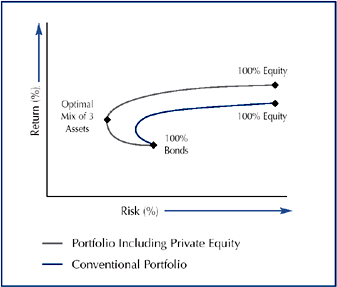
Simply put the reason to invest in private equity is to improve return characteristics of an investment portfolio, while it potentially correlate to increased risk.
The long-term returns of private equity represent a premium to the performance of public equities.
This has been the case in the US for over 20 years and also in Europe, following an increase in the number of private equity funds, for over 10 years.

“The Yale Endowment states, ‘Private equity offers extremely attractive long-term risk-adjusted return characteristics…’”

Private equity has arrived as a major component of the alternative investment universe and is now broadly accepted as an established asset class within many institutional portfolios. Many investors with little or no existing allocation to private equity are now considering establishing or significantly expanding their private equity programs.

As nicely presented by EVCA, adding private equity to a balanced portfolio (bond and public securities) can reduce volatility and contribute to an overall improvement in risk profile.

Portfolio

Funding Rejection

Based on statistics gleaned from Venture Economics, ACA , PriceWaterhouseCoopers entrepreneurs try to start some 5 million businesses in the U.S. every year. Of that total, 400,000 are looking for capital beyond what they can charge to their credit cards.
Most of them approach Friends, Family and Angels. From those approaching VCs less than 2% receive funding.

Having said that, investment decisions are inherently subjective and in no way reflects any negative sentiment toward the business idea.

Scott Cook (Intuit) has been rejected 39 times before it was funded.
Cisco was rejected by 76 VCs before they got funding.

And here is a list of companies Bessemer Venture didn’t invest in:
http://www.bvp.com/port/anti.asp

The Birth!

Being in constant touch with entrepreneurs and investors and
exposed to common issues inspired us to start this blog.

The purpose is to openly discuss and analyze issues facing
early stage companies and their investors.

Please note that the statements and opinions expressed here are solely those of their authors and are only meant to encourage and foster additional comments, suggestions and insights.

So don’t be shy. Get in touch and share your stories and experiences.

Heptalysis Needs You!